
Spectrum auction software for national regulators.
A web-based platform for running spectrum awards, with pre-configured templates for the auction formats that won Milgrom and Wilson the 2020 Nobel Prize in economics — and people who have sat in the room for twelve live auctions.
What the platform does
With extensive experience in the telecommunications sector, we have helped regulatory bodies allocate valuable spectrum resources across Europe and Africa.
An efficient, transparent process Spectrum allocation that participants and the public can follow and verify.
Modern auction formats SMRA, CCA and hybrids, with the variations each design allows for information disclosure and activity rules.
Customisable pre-defined templates Start from a proven format and adapt it, rather than building a design from nothing.
Single-band, multi-band and multi-procedure From a single 700 MHz award to the nine-band consultation we ran for Portugal.
National and regional lots Both in the same auction, as in Croatia’s 2021 award.
Straightforward for bidders and auctioneer alike Bidders generally grasp the interface quickly, which matters when a round is timed.
Dedicated specialist support Before, during and after the auction — not a ticket queue.
Optional live public dashboard For the media and the general public, where the auction rules permit it.
SMRA, CCA, and knowing which one you need.
Choosing the format is the most consequential decision in an auction design, and it is made before a line of configuration is written. A Combinatorial Clock Auction can produce a more efficient allocation where bidders need complementary blocks to build a viable network. Where that aggregation risk is low, a simpler format will serve you better and cost less to run.
We have delivered both, including formats written from scratch to a ministry’s own rules, as in Finland in 2018.
Formats we have run
In production, not in principle
- SMRA — Tanzania, 700 MHz
- Modified SMRA — Finland, 26 GHz
- Combinatorial Clock Auction — Montenegro, multi-band 4G
- SMRA–Clock hybrid — mid-band awards
- Regulator’s own rules — Finland 2018, Poland
Two interfaces, one auction
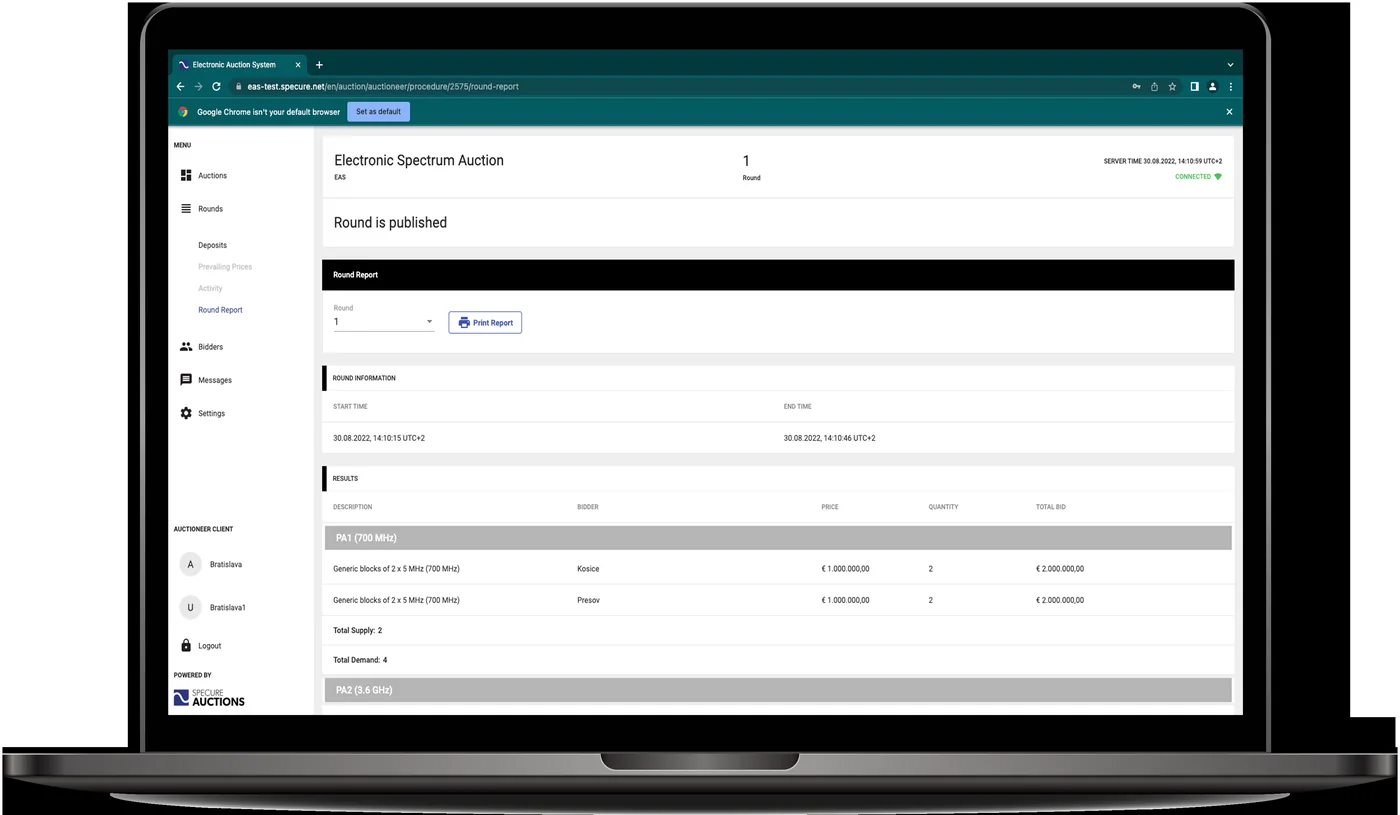
The auctioneer’s interface
Create an auction and configure its parameters — price increments, schedule, round starts. Evaluate results as they come in, and communicate with bidders through announcements and direct messages. A consolidated reporting module shows all bidding activity and lets the auctioneer monitor rounds in real time.
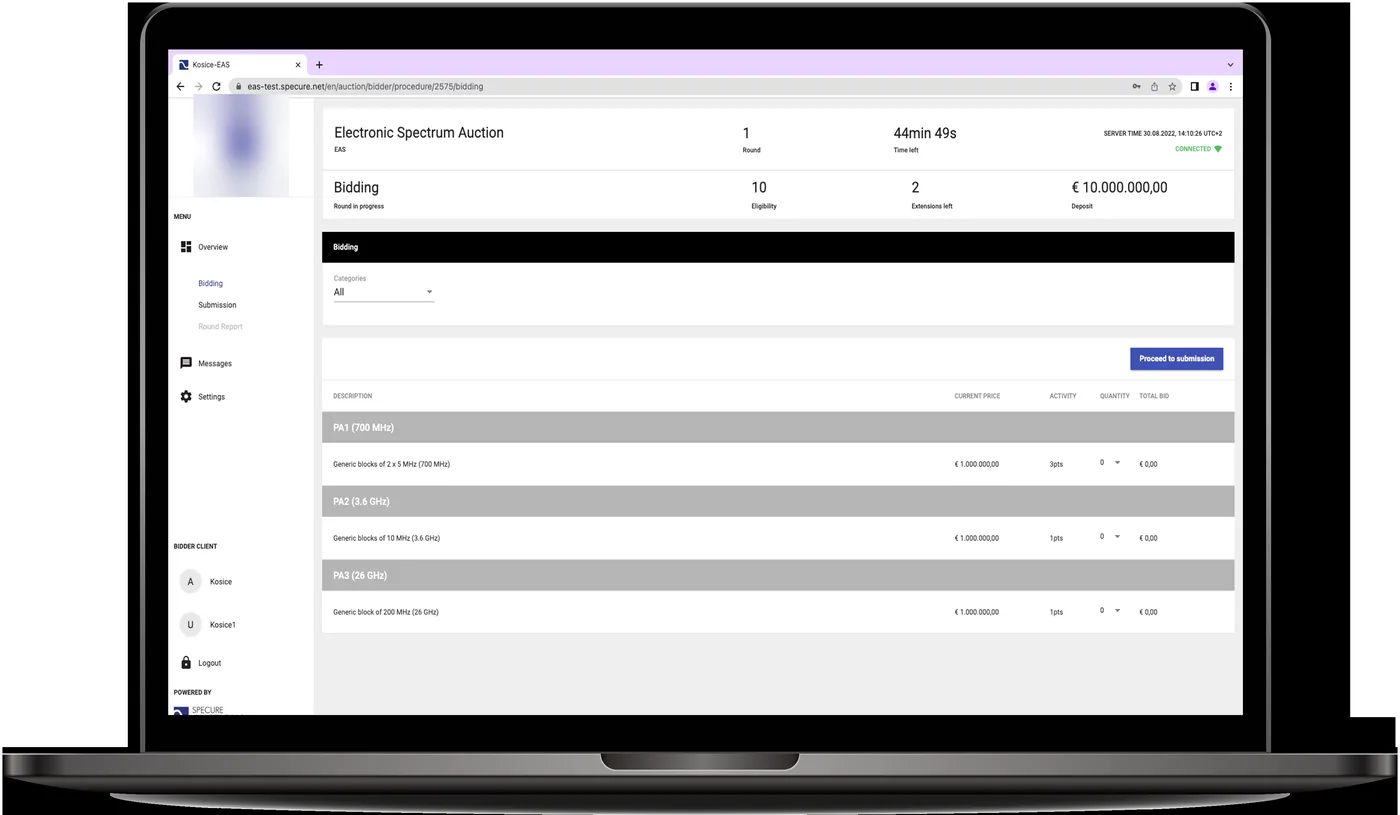
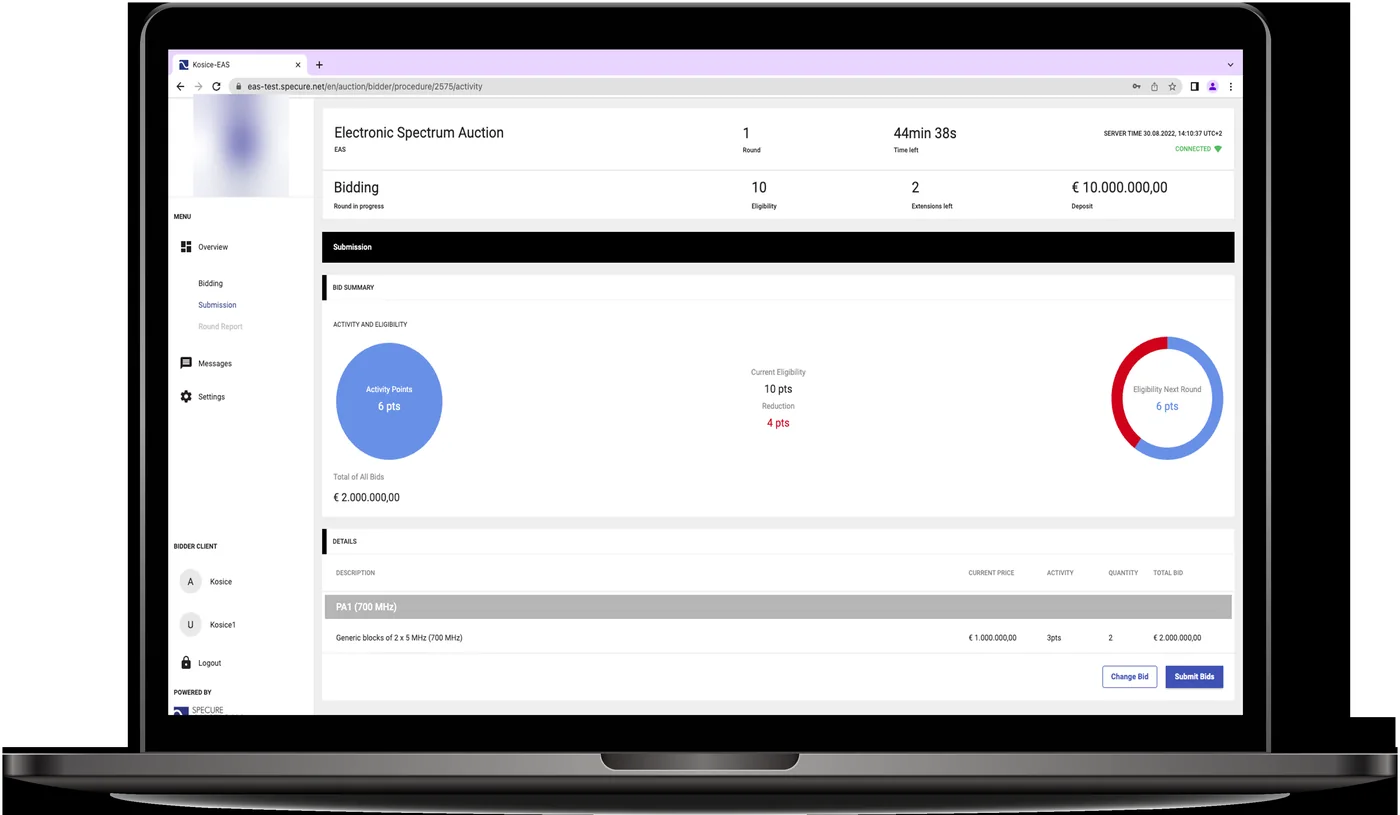
The bidder’s interface
Review the lots on offer, prepare bids and submit them against a clock synchronised with the server, with a countdown so nobody is guessing how long is left. Every bid is validated before final submission and summarised back to the bidder — an extra layer of assurance at the moment it matters. Bidders can follow their own progress and download reports in several formats.
Built for an event that cannot be re-run.
A spectrum auction happens once. The platform is a combination of hardware, software and a secured public-key infrastructure: all data is encrypted in transmission, and the identity of every party is verified using electronic certificates. Hosting and authentication use industry-grade precautions throughout.
Real-time processing of complex allocation algorithms happens fast enough that a round never waits on the software.
Track record
Twelve auctions, none overturned
No auction we have run has been overturned on appeal. For a regulator, a result that survives legal challenge is the only result that counts.
A repeatable process, start to finish
We follow the same sequence on every auction project. It is what makes a seamless execution repeatable rather than lucky.
-
Initial meeting and auction rules
We work through the rules you have, or the rules you are still drafting, and establish what the format has to support.
-
Iterative development
We implement the rules and features, with regular meetings throughout rather than a single handover at the end.
-
Testing and refinement
Thorough validation against the rules, and improvements driven by your feedback. Steps two and three repeat until the auction behaves exactly as the rules say it should.
-
Training and mock auctions
Training for the auctioneer and the bidders on the specific format, followed by one or several mock auctions so that nobody meets the interface for the first time on the day.
-
Live auction support
Maintenance and hands-on support for the auctioneer while the auction runs.
-
Post-auction support and reporting
Post-mortem reports and whatever follow-up the award process requires.
What a client said
“According to the assessment of all participants, the spectrum auction has been prepared and implemented transparently and accurately, under equal and competitive conditions, without mistakes and any appeal proceeding.”
For consultancies who advise regulators
If you already advise regulatory bodies, our partnership programme adds the tooling and the auction delivery experience to your practice, so you can take on spectrum work without building a platform first.
We already work this way with specialist consultancies: Auctiometrix, a spin-off of Erasmus University Rotterdam advising on auction design and bid strategy, on Belgium, both Finnish auctions, Montenegro’s 2022 award and the Portuguese consultancy; Coleago Consulting, among the leading advisers on spectrum valuation and bidding strategy, on Tanzania and Montenegro’s 2015–17 combinatorial clock auction; and KPMG, as a consortium for both Croatian auctions.
Let’s organise a successful spectrum auction together.
Get hands-on experience with the software and we will work out the best way to collaborate.